This post contains paid and/or affiliate links. I make a small commission at no extra cost to you. Please see our Privacy Policy.
You brought home a furry chaos machine, and now you want basic peace? Perfect. How to Train a Dog: Teaching your dog to sit, stay, and come at home gives you control, keeps your dog safe, and, honestly, makes life way more enjoyable.
You don’t need fancy gear or a dog whisperer voice—just good timing, tasty treats, and a plan. Let’s get you three essential commands that actually stick.
Table of Contents

Set Up Your Home Training Zone
Keep it boring at first. Distractions = failure, and we’re not collecting L’s today.
Pick a quiet space with minimal noise, few people, and no tempting toys lying around. Your dog should feel calm, curious, and ready to work. Must-haves:
- Small, soft treats that your dog loves (pea-sized: chicken, cheese, or store-bought training treats)
- Clicker or marker word like “Yes!” for timing
- Leash for early “stay” and “come” work
- Patience and short sessions: 3–5 minutes, 2–4 times a day
FYI: Tired dogs learn better. A quick sniffy walk before training can help them focus.
Teach “Sit” First (It’s Your Foundation)
“Sit” becomes your dog’s default polite move.
You’ll use it for everything—before meals, doorways, and greetings. It’s also the gateway to “stay.”
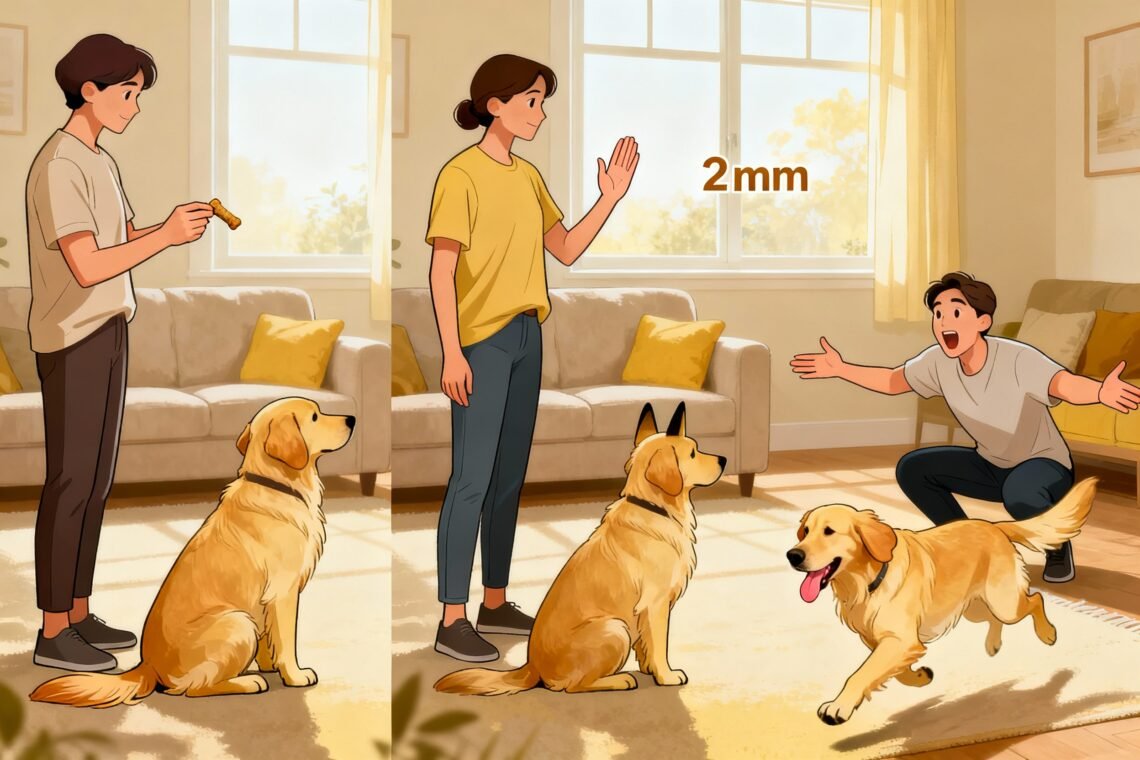
- Lure the sit: Hold a treat to your dog’s nose, then move it straight up and back over their head. As their head tilts, their butt should drop.
- Mark and reward: The second the butt hits the floor, say “Yes!” and give the treat.
Timing matters like crazy.
- Add the cue: After 5–10 successful lures, say “Sit,” then lure. Mark and reward.
- Fade the lure: Move your empty hand the same way, reward from the other hand or a treat pouch.

- SUPER HIGH BOUNCE: Take fetch to new heights with the Ultra Ball, compatible with medium Chuckit! launchers. Made from d…
- DURABLE RUBBER BALL: Built tough for revolutionary fetch games, our rugged dog toy features a textured surface and a thi…
- SIZING MATTERS: The medium Ultra Ball is 2.5 inches in diameter and best suited for breeds weighing 20-60lbs. Dog balls …
- Great Value Set: This assortment value bundle plush pet toy contains 5 pack: koala, sloth, monkey, gorilla, frog. The fu…
- No Stuffing Squeaky Toys: Crinkle paper all over the body and a squeaker in the head, keeping your dog entertained for h…
- Tug of War for Bonding & Training:Designed with Pull-tab for interactive fun, this puppy toy is perfect for games like t…
- Three Fun Plush Shapes:Fish, chili pepper and cucumber cat toys designed to attract kittens and indoor cats for endless …
- Natural Catnip Filled:Each toy is filled with premium natural catnip to stimulate your cats senses, promote activity, an…
- Soft, Durable and Chew-Friendly:Made with high-quality plush and soft stuffing, these cat toys are perfect for cats to k…
Pro tip: If your dog hops or backs up, practice near a wall so they can’t moonwalk out of position. Also, reward fast sits sometimes with a mini jackpot (2–3 treats).
Speed matters.
Common Sit Mistakes
- Repeating the cue: Say it once. If they don’t sit, help with the hand signal.
- Holding the treat too high: You’ll get a jump, not a sit. Keep it close to the nose.
- Training when hyped: Zoomies = zero brain cells.
Try again later.

Turn “Sit” Into “Stay” (Your Sanity Saver)
“Stay” keeps your dog safe and keeps your coffee in your cup. Start tiny. Like micro tiny.
You’re building a muscle.
- Set the position: Ask for “Sit.” Open your palm like a little stop sign and say “Stay.”
- Count to one: Literally one second. Then mark “Yes!” and reward right to their mouth.
- Release word: Say a consistent release like “Free!” or “Break!” then toss a treat to get them moving. The release ends the job.
- Increase duration: Go from 1 to 3 to 5 seconds over a few reps.
Reward in place, then release.
- Add distance: Step back one step, return to your dog, reward, then release. Dog stays while you move, not the other way around.
- Layer distractions: Scratch your head, take a side step, put a treat on the floor (cover it with your shoe if you must). Reward success.
Golden rule: If your dog breaks, you went too far.
Reset, lower the difficulty, and win the rep.
Stay Troubleshooting
- Use high-value treats at first. Switch to variable rewards later.
- Reward in position. Don’t call them to you for the treat or you’ll accidentally teach “come” instead of “stay.”
- Practice short and sweet.
Five perfect reps beat 30 sloppy ones, IMO.
Make “Come” Rock-Solid (Recall That Works)
Recall is the emergency brake. We want your dog sprinting to you like you’re the ice cream truck.
- Start indoors: Clip on a leash or long line for safety later, but begin in the hallway or living room.
- Happy tone, clear cue: Say your dog’s name and “Come!” in a bright voice. Kneel or lean back slightly.
Open your arms.
- Mark the turn: The instant your dog commits and turns toward you, say “Yes!” Then reward generously when they arrive.
- Pay big: Give a handful of treats or a 5-second tug party. Make arriving the best thing ever.
- Repeat in different rooms: Then add distance, then add mild distractions. Progress slowly.
Never call your dog for stuff they hate (baths, nail trims, leaving the park).
Go get them calmly for that. Protect the cue. You want “Come!” to mean “jackpot + praise,” not “party’s over.”
Long-Line Games for Recall
- Ping-pong recall: Two people 10–15 feet apart, take turns calling and rewarding.
- Find me: Hide in the house, call once, celebrate like you won the lottery when they find you.
- Chase me: Call “Come!” then jog backward.
Moving away triggers pursuit—use it.

Timing, Rewards, and Real-Life Proofing
Training fails when you change the environment too fast. Proof the behavior step-by-step.
Three D’s: Duration, Distance, Distraction
- Duration: Hold the position longer (sit/stay).
- Distance: You move farther away.
- Distraction: Add small temptations (doorbell sounds, treat on floor).
Only change one D at a time. If your dog flops, dial it back and get fast wins again.
Smart Rewarding

- Perfect Pup Bundle: This training treat bundle is a great companion to our free training course. You get (1) 4 oz Chicke…
- Lots of flavor, not fillers: Just three simple, all-natural ingredients mean low calories and high nutritional value, ma…
- Ready for training, wherever you are: The best training is consistent training. Our small treats are lightweight and per…
- Start high-value (chicken, cheese), then mix in kibble or praise as they master it.
- Use variable rewards: Sometimes a single treat, sometimes a mini jackpot.
Keeps dogs guessing and engaged.
- Life rewards: Sit before going outside, stay while the food bowl lowers, come to start a walk. Real life pays, too.
Common Pitfalls (And How To Dodge Them)
Let’s save you weeks of “Why won’t he listen?!”
- Long sessions: Keep it short. End on a win.
Always.
- Inconsistent cues: Pick one word per command and stick to it. “Come” is not “Here, buddy, let’s gooo.”
- Late rewards: Mark behavior the moment it happens. Your “Yes!” buys you time to deliver.
- Training only at home: Once reliable, practice in the yard, then the sidewalk, then the park. Increase challenge slowly.
- Free-for-all door greetings: Ask for a sit-stay before opening the door.
Reward calm. Rinse, repeat.
Sample 10-Minute Training Routine
Use this as your daily template. Simple, fast, effective.
- 1 minute warm-up: 5 easy sits with treats.
- 3 minutes stay work: Sit-stay for 3–5 seconds, hand signal, reward in place, release.
Build to 10–15 seconds.
- 4 minutes recall: Short-distance “Come!” from another room or across the hall. Big payoffs.
- 2 minutes cool-down: Easy trick (hand target or down), then play or sniffy time as a life reward.
IMO, consistency beats intensity. A little every day skyrockets results.
FAQ
How long until my dog gets it?
Most dogs learn “sit” in a day or two, “stay” in about a week, and “come” in a few weeks with daily practice.
Reliability around distractions takes longer. Think in terms of reps, not days: aim for 50–100 good reps per skill over time.
What if my dog ignores treats?
Try higher-value food (warm chicken, soft cheese), smaller pieces, and train before meals. If food still fails, use toys as rewards.
Many working breeds will sprint for a tug game. Also, reduce distractions and shorten sessions.
Should I use a clicker?
If you like precise timing, yes. A clicker marks the exact second your dog does the right thing.
If you don’t want to juggle gadgets, use a crisp “Yes!” as your marker word. Consistency matters more than the tool.
Can I say “No” when they mess up?
Skip the scolding. It muddies the water.
Instead, calmly reset and lower the difficulty. Reward what you like, prevent what you don’t, and keep the vibe positive. Dogs repeat what pays.
Is a long line necessary for recall?
Not required, but super helpful outside.
A 15–30 foot long line gives freedom without risk. You can reinforce “Come!” safely while you proof against squirrels, smells, and other chaos agents.
What if my dog breaks the stay constantly?
You advanced too fast. Move closer, shorten the time, and increase rewards.
Use your release word every single rep. If needed, practice with a leash on indoors to prevent creeping.
How long until my dog gets it?
Most dogs learn “sit” in a day or two, “stay” in about a week, and “come” in a few weeks with daily practice.
Reliability around distractions takes longer. Think in terms of reps, not days: aim for 50–100 good reps per skill over time.
What if my dog ignores treats?
Try higher-value food (warm chicken, soft cheese), smaller pieces, and train before meals. If food still fails, use toys as rewards.
Many working breeds will sprint for a tug game. Also reduce distractions and shorten sessions.
Should I use a clicker?
If you like precise timing, yes. A clicker marks the exact second your dog does the right thing.
If you don’t want to juggle gadgets, use a crisp “Yes!” as your marker word. Consistency matters more than the tool.
Can I say “No” when they mess up?
Skip the scolding. It muddies the water.
Instead, calmly reset and lower difficulty. Reward what you like, prevent what you don’t, and keep the vibe positive. Dogs repeat what pays.
Is a long line necessary for recall?
Not required, but super helpful outside.
A 15–30 foot long line gives freedom without risk. You can reinforce “Come!” safely while you proof against squirrels, smells, and other chaos agents.
What if my dog breaks the stay constantly?
You advanced too fast. Move closer, shorten the time, and increase rewards.
Use your release word every single rep. If needed, practice with a leash on indoors to prevent creeping.
Conclusion
You don’t need magic. You need short sessions, clear cues, and rewards your dog cares about.
Nail “sit,” build a reliable “stay,” and make “come” a party every time. Keep it fun, keep it consistent, and celebrate the tiny wins. Your future self—walking a polite, responsive dog—will thank you.
This post contains paid and/or affiliate links. I make a small commission at no extra cost to you. Please see our Privacy Policy.


